
To effectively tackle climate change, we need a common yardstick to compare the warming impact of different greenhouse gases. The Global Warming Potential (GWP) is the most widely used tool for this purpose.
A large share of aviation’s warming effect comes from non-CO₂ sources. and this paper breaks down, in plain language, what GWP means and why it’s tricky to apply to these non-CO₂ effects. Relying on the standard 100-year GWP can mask the strong, short-term warming power of contrails—leading to an underestimate of aviation’s true climate impact. Recognizing this gap is the first step toward accurately measuring, and ultimately cutting, the full climate footprint of flying.
What is Global Warming Potential (GWP)?
Global Warming Potential (GWP) is a measure of how much heat a greenhouse gas traps in the atmosphere over a specific time period, relative to carbon dioxide. It is calculated as the time-integrated radiative forcing (the change in energy in the atmosphere) from a pulse emission of one ton of a gas, divided by the radiative forcing of one ton of CO₂ over the same period. By converting emissions of gases like methane (CH₄) or nitrous oxide (N₂O) into a “CO₂-equivalent” (CO₂-eq), GWP provides a common unit for policymakers and industries to track and regulate emissions.
The Importance of Time Horizons: GWP20 vs. GWP100
A crucial element of GWP is the chosen time horizon—the period over which its warming effect is calculated. The most common standard is 100 years (GWP100), which evaluates the impact over a full century. A shorter 20-year (GWP20) horizon is also used to assess impacts on a more immediate timescale.
The choice of timeframe is critical because it changes the emphasis of the measurement. GWP20 captures the potent, immediate warming impact that a gas has in the near term. In contrast, GWP100 averages a gas’s impact over a much longer period, giving a better sense of its long-term contribution to warming. Therefore, the same gas emission will have a different GWP value depending entirely on whether its near-term or long-term effect is being measured.
Contrails and GWP: A Complex Relationship
Contrails, and the expansive cirrus clouds they can generate, represent a major component of aviation’s non-CO₂ warming effect. The challenge is that their warming effect is both powerful and brief, often lasting only a few hours. This short lifespan creates a measurement problem when using the standard GWP100 metric. By averaging the impact over a 100-year period, GWP100 diminishes the potent, near-term warming caused by contrails, especially when compared to the steady, long-term warming from CO₂.
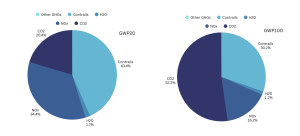
Case Study: Comparing Long-Term (GWP100) and Short-Term (GWP20) Climate Impact from a 7-Day Airline Analysis
The Global Warming Potential (GWP) is an essential and widely used tool in climate policy, providing a simplified way to compare the climate impacts of different greenhouse gases. However, its application, particularly for short-lived climate pollutants like contrails, has known limitations.
Conclusion
The choice of a climate metric is not merely a technical detail; it has significant implications for how we prioritize mitigation efforts and design effective climate policies. While GWP100 remains the international standard, the scientific community continues to explore and refine alternatives. Ultimately, the selection of the most suitable metric requires a trade-off between simplicity, compatibility with existing policies, and scientific accuracy, all of which are crucial for effectively navigating the path to a sustainable and climate-neutral future.
There are no blocks availables